Category: Seller Guide
Fake B2B Leads in India: How to Spot Them, and Why Directories Keep Sending Them
By Tradoi Team · Published 2026-08-27
A fake B2B lead is an inquiry that was never going to become an order: no real business behind it, no intention to buy, or a genuine requirement already sold to a dozen sellers before you. Three checks catch most of them in five minutes. Look the company up in a public register. Call the number once. Ask for a purchase order from a business email.
If you sell on a paid directory you know the pattern. Some inquiries are brokers and bots. Plenty are real people who were never buying. And a large share are genuine requirements four other suppliers got the same morning, which lands on you exactly like a fake one: an hour spent, nothing closed.
What follows is the field guide. Ten patterns with the check that settles each, a five-minute routine for your inbox tonight, and a short answer to why the leads keep arriving in that shape.
The Short Version
- A fake B2B lead was never going to convert: no real business behind it, no intention to buy, or a requirement several competitors already have. Ten patterns cover almost all of them.
- Seven waste your day. Three take money: the sample farmer, the pay-first purchase order, and the doctored payment screenshot.
- Three checks settle most of it. Look the company up. Call once at a working hour. Ask for a purchase order from a business email.
- Grade each inquiry by its flag count. One is normal, two or three means verify before you call, four or more means walk away.
What a Fake Inquiry Looks Like Before You Call
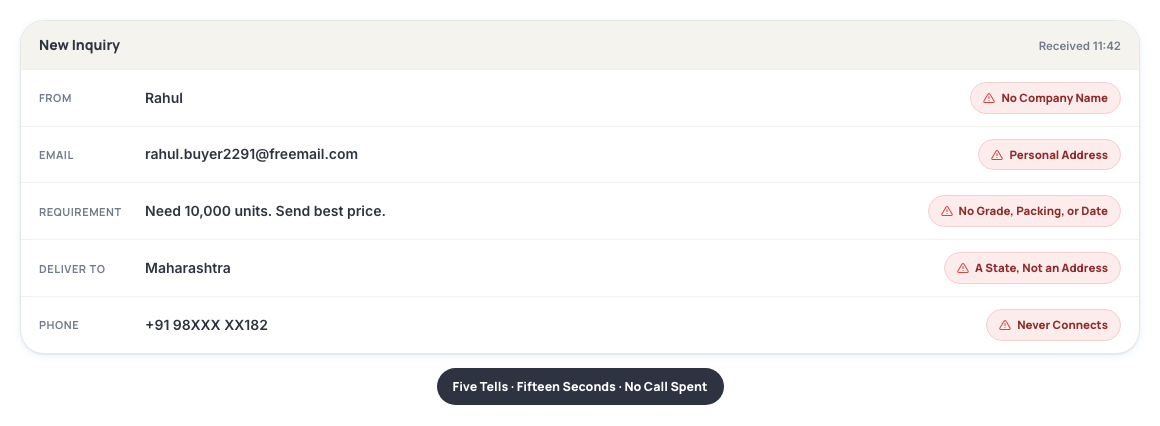
Almost every fake lead is legible before you dial. Not certain, but legible. The inquiry carries the tells on its face, and reading it takes fifteen seconds once you know what to look for.
The Ten Patterns, and the Check That Settles Each
Hundreds of bad leads reduce to ten patterns. The first seven cost you a call and an afternoon. The last three are different in kind, because wasting your time is not the point, taking something is. In those, the defense is a rule you set in advance, not a judgment you make while somebody presses you to hurry.
| Pattern | What It Looks Like | The Check That Settles It |
|---|---|---|
| No Business Behind It | A first name, a free-mail address, and no company named anywhere in the message. | Search the company on the MCA portal. If they gave a tax registration number, check it on the GST portal. Nothing to search is your answer. |
| The 10,000-Unit First Message | A round five-figure quantity with no grade, packing, or delivery date. Volume is the cheapest way to make a seller call back. | Ask for grade, packing, and required delivery date. A buyer answers all three. A fake one repeats the quantity. |
| The Number That Never Answers | Rings out every time, or takes WhatsApp and refuses calls. Numbers get harvested and recycled through lists for years. | One call at a working hour, then stop. A buyer who will not take one short call before asking your best price is telling you something. |
| The Competitor in a Buyer's Name | Presses hard on price, minimum quantity, and payment terms. Asks nothing about your capacity or the delivery. | Ask what the material is for and where it ships. A buyer answers in a line. A competitor changes the subject. |
| The Same Inquiry, Three Directories | Identical wording from two or three platforms in a week, sometimes under a different name. Brokers scrape published requirements and resell them. | Keep the opening line of every inquiry. Repeats surface fast, and tell you how stale the lead is. |
| The Lead Twenty Sellers Already Have | Genuine and useless. The buyer has taken nine calls since breakfast and stopped picking up. | Ask how many suppliers have called. Most will tell you, and the number is higher than you guessed. |
| The Borrowed Factory Photograph | An export inquiry from a confident website with a warehouse photo and an address that resolves to nothing. | Reverse image search the photograph. Twenty other sites is your answer. The section below has the full playbook. |
| The Sample Farmer · Costs Money | Several variants requested before any commercial talk, to a residential address, on your courier account. No order follows, and neither do the samples. | A standing rule, not a decision each time: samples go out after the commercial questions are answered, against a courier account or a small refundable charge. |
| The Pay-First Purchase Order · Costs Money | An official-looking order, sometimes large enough to change your year, with a registration charge, security deposit, or earnest-money amount buried in it. | No genuine buyer requires a supplier to pay in order to be paid. Money moving from you toward the buyer ends the conversation, whatever the paperwork says. |
| The Payment Screenshot · Costs Money | A screenshot of a completed transfer and hard pressure to dispatch today. A variant overpays, then asks you to refund the difference at once. | Goods move when the money is in your account and you have seen it there yourself. Not a screenshot, not a reference number, not a promise. |
The Five-Minute Check You Can Run Tonight
- Split the last twenty inquiries into two piles: the ones that named a business, and the ones that did not. The split tells you what you have been paying for.
- Check every registration number you were given on the official portal. Under a minute each, and the highest-value check here.
- Call each unchecked number once, at a working hour. Mark the ones that never connect and stop.
- Reply to whatever survives with one message asking for grade, packing, and delivery date.
- Quote whoever answers all three properly, and the same day. Let the rest go.
How Many Flags Before You Walk Away?
One flag is normal. Genuine buyers write short messages from personal addresses all the time. What matters is how many stack up on one inquiry, because the tells are independent, so two together are far worse than twice as bad.

The International Buyer Who Isn't
The first export inquiry is the one that gets past every check. It lands on a slow Tuesday, from a company in Dubai or Lagos or Rotterdam, asking about a container quantity in confident English. A seller who would never wire money to a stranger in Ludhiana does it for a buyer six thousand kilometers away. That is not naivety. An export order is the biggest thing most sellers have been offered, and hope is a poor auditor. The shape rarely varies: the order is agreed quickly and generously, and then the fees begin. Never one large payment, always a ladder of small reasonable ones.
The Fee Ladder
- Registration or Vendor-Approval Fee: you must be listed with their procurement department, or a government supplier portal, before the order is released.
- Inspection or Certification Charge: a named agency must certify the goods, and you are asked to pay that agency directly.
- Customs or Port-Clearance Fee: an unexpected charge at their end that only you, apparently, can settle.
- Agent's or Lawyer's Fee: a contract or notarized power of attorney costing a few hundred dollars to draw up.
- Bank Charges on a Fake Letter of Credit: an LC arrives by email and their bank wants a handling fee first.
The Version That Costs Only Time
- Weeks of Warm Messages: samples couriered at your expense, the specification refined three times, board approval always coming next week.
- Never a Proforma Acted On: it takes no money, only your best weeks, which is why it is harder to spot than the fee ladder.
Three Checks Before You Take It Seriously
- Look them up where they live. Most countries run a public company register, and a real importer gives you their import license number unprompted.
- Check the company, not the message: domain age, a reverse image search of the premises photo, and a named person on LinkedIn whose email domain matches the one writing to you.
- Send a proforma invoice and watch what comes back. An LC draft or an advance means you have a buyer. A fee request means you have your answer. Our guide to finding international buyers from India covers the payment terms to ask for.
Why Directories Keep Sending Them
Sellers usually explain this with character: somebody at the platform is careless, or greedy, or asleep at the desk. That is comforting and it is wrong. The leads arrive in this shape because of how the business earns, and the economics are not hidden.
The seller pays for inquiry volume, so volume is what the system produces. One requirement can go to several suppliers at once: IndiaMART's own help center defines a BuyLead as a buyer requirement "filtered by IndiaMART and shared with the suppliers dealing in those products/services" (IndiaMART help center). Verification is sold rather than required, with TrustSEAL described as a paid service (IndiaMART help center), and the buyer is not checked. Nothing is recorded once the inquiry lands, so somebody who wasted ten sellers' afternoons on Monday starts Tuesday clean.
To be fair, the directories are not creating the fraudsters, and IndiaMART is the most transparent operator here, publishing audited metrics quarterly as a listed company (IndiaMART investor disclosures). Our view, as opinion: the problem is not intent, it is that a business paid by lead volume has no reason to filter. We take that apart in our IndiaMART comparison.
What We See at the Door
A number from our own side of the counter. Tradoi checks a business before it can list anything: phone, email, and a review of its business registration certificate. As of August 2026, roughly one in three businesses that began registering more than a month ago still have not cleared it. That counts profiles started, including ones our team opened on a call, rather than people, and it moves as we grow, so treat it as a snapshot. It does not mean a third are fake. What it shows is the gap between wanting to appear on a marketplace and proving you are one. On an open directory that gap is invisible, because there is nothing to clear, and all of that third would be listed and inquiring by now. That is the design: verification is the entry condition rather than a badge, an inquiry is matched to the few suppliers who fit instead of resold, and a completed order leaves a record that builds a verified standing on both sides. The sellers joining Tradoi from the big directories tell us the same story: they were paying for volume and sorting strangers for free.
Stop Qualifying Strangers for Free. Open a free Digital Store and take inquiries from buyers verified before they reached you. Start Selling, Free
What to Do Next
Tonight, run the five-minute check on your last twenty inquiries and count how many named a real, reachable business. Tomorrow, divide your monthly spend on that channel by that number. Cost per genuine, contactable buyer is the only lead metric worth tracking, and no lead seller will calculate it for you.
Then put two questions to whichever platform is selling to you. How many other suppliers receive the same inquiry I do, and is the buyer checked before they can reach me. The answers tell you whether you have a filtering problem, which the checks above fix, or a sourcing problem, which checking never will.
You are running quality control on strangers, unpaid, before you know whether there is an order at the end of it.
Common Questions
How do I know if a buyer inquiry is fake?
Read it before you dial. The common tells are a missing company name, a free-mail address, a large round quantity with no grade, packing, or delivery date, and a state given instead of a delivery address. Then run three checks: search the company, call once at a working hour, and ask for a purchase order from a business email. Genuine buyers clear all three.
Why do I get so many fake leads on IndiaMART?
Because of how the model earns, not anyone's intent. Sellers pay for inquiry volume, so volume is what the system produces, and one requirement can be shared with several suppliers at once. IndiaMART's help center defines a BuyLead as a requirement filtered and shared with the suppliers dealing in those products. The buyer is not verified either, so the sorting falls to you.
Can I get a refund for fake leads?
Usually harder than sellers expect, and it depends entirely on the contract you signed. Refund terms on Indian B2B directory packages vary and are not always published, so we will not tell you what yours says. Read the agreement, get the refund position in writing before you renew, and prefer a short trial to a multi-year commitment.
How do I verify a buyer's GST number?
Ask for the number, then check it on the official GST portal using the Search Taxpayer tool. It returns the registered legal name, the trade name, the state, the date of registration, and whether the status is active. The name it returns has to match the business the inquiry came from. A buyer who will not give you a number is telling you something.
What should I do if a buyer asks for samples before paying?
Do not refuse, price it. Samples go out once they have confirmed the specification and the intended order size, with the courier on their account or against a small charge refunded on the first order. Genuine buyers accept that without a pause. Anyone who argues at length about a courier charge was not going to order.
Is a WhatsApp-only buyer a fake lead?
Not automatically. Plenty of genuine Indian buyers run their entire purchasing on WhatsApp and prefer it to a call. What matters is what happens when you ask for one short conversation before quoting. A real buyer takes the call or explains why they cannot. Someone who wants your best rate but will never speak to you is doing something other than buying.
How do I find genuine buyer leads in India?
Change where the inquiry comes from instead of getting better at sorting. Source from a platform that checks the buyer before they can contact you and does not resell one requirement to several suppliers. Then track cost per genuine, contactable buyer rather than leads received. That figure compares any two channels honestly and it usually reorders your spending.
An international buyer asked me to pay a security deposit or registration fee. Is it a scam?
Yes. Treat it as one and stop replying. A genuine importer pays you, by letter of credit through their bank or by advance against the shipping documents. There is no legitimate arrangement in which a foreign buyer requires an Indian supplier to send money first, under any name: registration, vendor approval, inspection, customs, or an agent's charges. The direction of the money is the whole test.